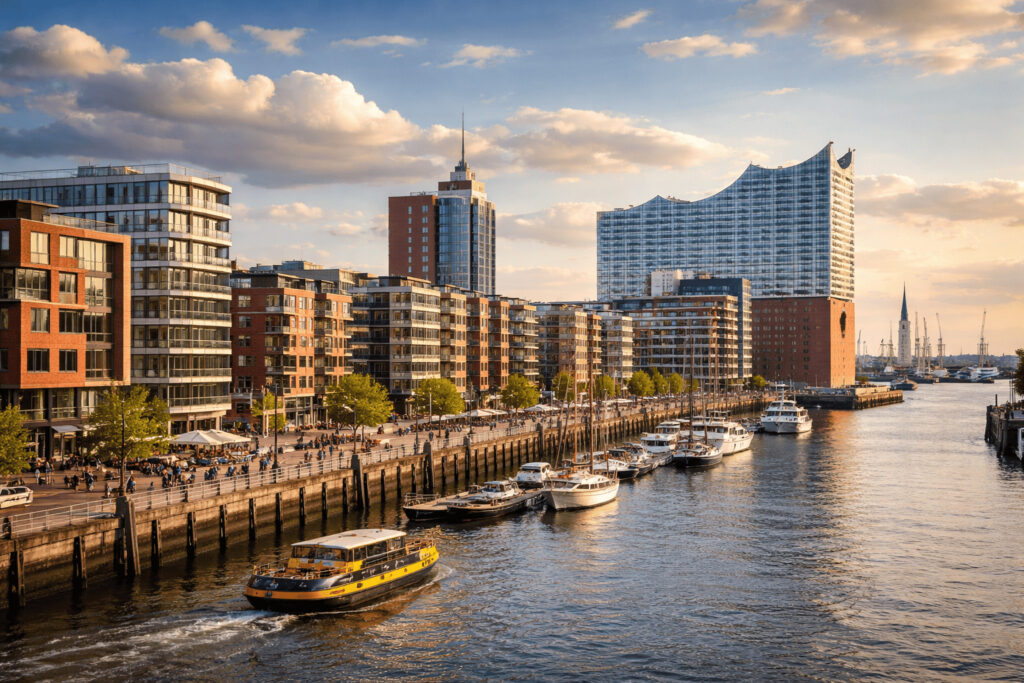
HafenCity
belongs to all of us
Share your opinion on the planned sale of HafenCity and take part in our anonymous survey.
We are a small group of five students working on a university project that addresses the question of how HafenCity can be democratized. What does that mean?
We are calling for genuine co-determination in urban planning. For us, that means that every person in Hamburg, regardless of whether they are rich or poor, regardless of their origin, skin color, language, or reality, should have the opportunity to participate in shaping our city if they so desire.
Our focus is on EVERYONE. It is important to us to give a voice to people who are marginalized in everyday life and planning, for example due to their origin, language barriers, poverty, physical and/or mental disabilities.

Wer sind Wir?
Wir sind eine kleine Gruppe aus fünf Studierenden und beschäftigen uns im Rahmen eines Uni-Projekts mit der Frage, wie die HafenCity demokratisiert werden kann. Was das heißt?
Wir fordern echte Mitbestimmung bei der Stadtgestaltung. Für uns bedeutet das: Jede Person in Hamburg egal ob: arm oder reich, egal welche Herkunft, Hautfarbe, Sprache oder Realität soll die Möglichkeit haben, an der Gestaltung unserer Stadt teilzunehmen, wenn sie das möchte.
Der Fokus für uns liegt bei ALLEN, uns ist es wichtig Menschen, die im Alltag und der Planung ausgegrenzt werden, zum Beispiel aufgrund von Herkunft, Sprachbarrieren, Armut, körperliche und/oder geistige Behinderung, eine Stimme zu geben die gehört wird.
HAMBURG BELONGS TO ALL OF US. WE WON’T LET THEM TAKE THAT AWAY FROM US!
Support us and take part in the survey.
Tell us what you want for your city.
Share the website with your family, friends, or just the next random person at the bus stop.

Why HafenCity for our project?
HafenCity is a deliberate political project that has been planned and implemented by HafenCity GmbH since 2001. Many promises were made: social housing, a neighborhood for everyone, a place where people could live together regardless of their income. A vibrant neighborhood.
These promises were made and not kept. Instead, a district has emerged that the majority cannot afford: empty office complexes, expensive restaurants, and shopping malls.
Another unusual problem is that even the city of Hamburg has little influence on the development plans, as HafenCity is not due to be sold back to the city in its entirety for another 15 years or so.
Until then, HafenCity GmbH has almost sole control over the use, development, and orientation of the district.
Put simply, HafenCity GmbH can do whatever it wants without hindrance or restrictions.
The planned construction of the Kühne Opera House makes this reality particularly clear. Although a large part of the city’s population is against this project, these voices are being ignored. In addition, the opera house is being financed by Klaus-Michael Kühne, whose family profited from war crimes and expropriations during the Nazi era. To this day, Kühne has avoided seriously addressing or taking responsibility for this past.
Why is opera construction so problematic?
The opera costs money. A lot of money.
Even if KMK claims to cover the construction costs, we know from the Elbphilharmonie, if nothing else, that such promises are worth little. The Elphi exceeded its original budget many times over, and in the end, the city had to step in. Public money that could be invested in education, affordable housing, aid for the needy, integration, and many other social causes. Instead, it is being burned on a prestige project, an architectural competition.
And the problem does not end with construction. Once the opera house is built, it will serve as another driver of division among people: rents will rise, neighborhoods will change, and people will be displaced. Access to the opera house itself will remain effectively reserved for a wealthy minority. While few can afford tickets, many will lose a publicly accessible space. Shared space will be privatized, both culturally and socially.
The location is particularly problematic. The Baakenhöft has a troubled history: as early as the 18th and 19th centuries, it served as a departure and arrival point for German soldiers and colonial forces. From here, people set out to wage war and participate in the genocide of the Nama and Herero peoples. A place that SHOULD have been used as a memorial and space for remembrance of colonial crimes is now to be concealed by a status symbol. Memory is being suppressed, history built over in favor of prestige, image, and capital.
UMFRAGE
This survey is anonymous.
No names, email addresses, or personal data will be stored.
The results will only be published in summary form.
What are you waiting for?
Ready to take the next step? Let’s bring your vision to life! Explore our services and get in touch today for a consultation. Together, we’ll make it happen.